
Hiking Mount Irau & Mossy Forest, Cameron Highlands: What to Know Before You Go
English | Bahasa Malaysia
A Guide to Hiking Mount Irau Mossy Forest Cameron Highlands
Cameron Highlands is one of Malaysia’s most popular highland getaways, best known for its cool weather, tea plantations, strawberry farms, and flower gardens.
But beyond the usual tourist stops, there is another side of Cameron Highlands that feels a little wilder: Mount Irau.
Standing at 2,110 metres above sea level, Mount Irau is the highest mountain in Cameron Highlands. The trail takes you through the famous Mossy Forest, a damp, misty forest, which — as the name suggests — is covered by layers of moss.
Hiking through the Mossy Forest will make you feel as though you’ve just stepped onto the set of the Lord of the Rings.
It’s no surprise that it was once ranked fifth on Lonely Planet’s list of the Most Instagrammable Forests in the World.
_(26185581515).jpg)
This post may contain affiliate links, which means I may earn a commission at no extra cost to you. As an Amazon Associate, I earn from qualifying purchases. For more details, please read my Privacy Policy.
Mount Irau Hike: Quick Guide
In a hurry? Here’s a quick guide:
Location: Brinchang, Cameron Highlands, Pahang
Height: 2,110 metres above sea level
Trail type: Muddy forest trail, mossy terrain, tree roots, ladders, ropes, and uneven ground
Difficulty: Easy to moderate, depending on your fitness and the trail condition
Duration: Around 6 to 7 hours for the full hike, including breaks
Permit required: Yes, for hiking beyond the Mossy Forest boardwalk
Guide required: Highly recommended
Best time to hike Mount Irau
The best time to hike Mount Irau is during the drier months, from around February to September. That said, Cameron Highlands weather can be unpredictable at any time of year. Mist, mud, and sudden rain are still possible during the “dry season”.
The Mossy Forest is typically closed to visitors in the monsoon season (November to January), due to an increased risk of heavy rain, landslides, and falling trees.
Before planning your hike, always check the latest trail status with:
- Pahang Forestry Department
- Your tour operator
- Local hiking guides
- Your accommodation in Cameron Highlands
Avoid weekends, public holidays, Chinese New Year, and school holidays if you dislike crowds and traffic.
For the best experience, start early in the morning. The forest is usually mistier then, which makes it extra atmospheric for photos. Just remember to pack a light jacket, as it gets a little chilly in the morning.
How to get to Mount Irau
Cameron Highlands does not have an airport or train station. The only way to get there is by road.
From Kuala Lumpur, the drive usually takes around 4 to 5 hours, depending on traffic.
You can also take a bus to Cameron Highlands from cities such as Kuala Lumpur, Ipoh, and Penang. Most buses stop in Tanah Rata, which is the main town and a convenient base for travelers without a car.
However, getting from town to the Mount Irau trailhead is another story.
You could arrange for a taxi to drop you off and pick you up at an agreed time. Grab is also available in Cameron Highlands, although availability may vary, so you could try your luck with that too.
If you’re self-driving, search for “Mossy Forest (Entrance Point)” on your map app. A word of caution though: the road up to the forest is narrow, with many sharp turns and potholes. It’s certainly not a road for nervous drivers.
A 4WD vehicle is the most practical way to reach the starting point. This was one of the main reasons I joined a tour, because all I had to do was turn up at the meeting point and wait for the transport to come pick me up.

How to book a Mount Irau hiking tour
You can usually book a Mount Irau hiking tour through:
- Your hotel, hostel, or guesthouse
- Online travel platforms such as Klook, Viator, GetYourGuide, or similar booking sites
- Local tour companies in Cameron Highlands
Some packages only include the hike, while others combine Mossy Forest with popular Cameron Highlands attractions such as BOH Tea Centre, strawberry farms, flower gardens, or butterfly farms.
Klook.comIf your main goal is to actually hike Mount Irau, read the itinerary carefully. Some tours only visit the Mossy Forest boardwalk and do not include the full hiking trail to Mini Irau or Mount Irau Peak.
I personally booked with Thrill Adventures (+60173570285), but you could also search online for other adventure companies to compare prices.
A proper Mount Irau hiking package usually includes:
- Hiking permit
- Mountain guide
- Entrance fee
- 4WD transport
- Packed lunch or snacks
- Basic first aid support
Prices vary, but expect guided hikes to cost more than a simple Mossy Forest sightseeing tour because of the permit, guide, and transport involved.
Do you need a permit to hike Mount Irau?
Yes, if you plan to hike beyond the Mossy Forest boardwalk towards Mini Irau or Mount Irau, you need a hiking permit from the forestry department.
This permit system was introduced to control visitor numbers and reduce damage to the delicate forest ecosystem. The Mossy Forest may look tough and ancient, but it’s actually fragile. Too many hikers, especially those walking off-trail, can damage the moss, plants, and soil.
Another purpose of the permit is to keep track of who enters and exits the trail, ensuring that everyone returns safely.
You can contact the forestry department directly, but the application process can be quite tedious, not to mention confusing.
Firstly, the website is entirely in Malay, making it almost impossible for foreign visitors or non-Malay speakers to navigate. Secondly, it has to be done at least a week in advance.
The easier option is to book with a licensed local hiking guide or tour company that will arrange the permit for you.
Can you go without a permit?
I’ve heard of some tourists who have found ways to dodge the fee and shared their tips online. Although I’m not a big fan of red tape myself, I would advise against that.
Not only could you face penalties if you’re caught, it’s also not cool to visit a place and break the local law.
Please don’t be that kind of tourist.
Can you climb Mount Irau without a guide?
Yes, hiking Mount Irau and the Mossy Forest independently is technically allowed if you have the necessary permit (see above).
However, I would only recommend this if you are an experienced hiker, confident with navigation, and properly prepared for slippery, muddy, low-visibility forest conditions.
The trail can be foggy, wet, muddy, and confusing. Tree roots crisscross the path, the ground can feel soft and hollow, and the forest can get eerily quiet at times. People have gotten lost or injured in the Mossy Forest before, especially when hiking without proper preparation.
If you’re a beginner, travelling alone, or unfamiliar with Malaysian hiking trails, join a guided hike. It makes the whole experience much easier and safer. The guide handles the permit, transport, timing, route, and safety.

My Mount Irau hiking experience
I arrived in Cameron Highlands a day before the hike and stayed at a budget hotel in Tanah Rata.
Our meeting point was at Cameron Square. We gathered early in the morning, still half-asleep and probably questioning our hobbies. As usual, I was the only one who had come alone. Everyone else seemed to be in pairs or small groups.
But at least I was not crashing some company’s team-building program this time, like I did at Slim River because I had no partner.
Once everyone arrived, we were given our packed lunch and drinking water. Then we climbed into the back of the 4WD and made our way past the rolling hills, vegetable farms, and tea plantations.
The drive itself already felt like part of the adventure. The road was narrow, winding, and bumpy enough to make me grateful I was not the one driving.
By around 8 a.m., we reached the starting point near Mossy Forest and did a quick warm-up, before beginning the hike.

The moment we stepped into the forest, the atmosphere changed completely.
The ground did not feel solid. It was soft, damp, and slightly spongy from layers of moss, mud, roots, fungi, and dead leaves. It felt like walking on a forest mattress that had been left outside for several centuries.
Everything was covered in moss: the ground, the trees, the roots, the branches. Combined with the mist, the forest felt like something out of a fairy tale — the spooky kind. It was also eerily quiet.

The trail alternated between soft moss, slippery roots, and large muddy puddles that looked shallow until they swallowed your foot whole.
We had learned quite early on to watch where we were stepping. Twice, I had to fish my shoes out of the mud.
Along the way, there were ferns, orchids, pitcher plants, moss gardens, and strange little forest details that our guide pointed out.
I would love to say I noticed everything because I am a deeply observant nature person, but honestly, I spent a lot of the hike figuring out where to step and trying not to fall.

As the hike continued, the trail became steeper. Some sections had ropes and ladders to help hikers climb up or down.
The tangled tree roots, which at first looked like obstacles, eventually became useful handholds and footholds.

I was glad that the other group members weren’t the kind of super-athletes who treat everything as a race. We hiked at a reasonable pace and waited for one another whenever someone needed a break.
After about two and a half hours of trekking plus plenty of breaks and photo stops, we reached our destination: a large clearing called Mini Irau (also known as Irau False Peak), which stands at around 2,030 meters above sea level.
To the left was a path that led onward to the real peak of Mount Irau, which was about another hour’s hike away. Unfortunately, the trail to Irau Peak was closed during our visit due to a landslide. The forestry department had declared it safe to hike only as far as Mini Irau.
We stopped at the clearing to have our lunch and take more pictures.
At 1.30 p.m., we began our descent.
The way down was not exactly easier. Descending slippery roots and mud requires concentration, especially when your legs are starting to complain.
Thankfully, the weather was kind to us. Although not sunny, it didn’t rain, and the temperatures had been pleasantly cooling.
Before leaving, don’t forget to climb up the 50-meter-tall observation tower at the end of the trail.
On a clear day, you’re supposedly rewarded with spectacular views of the surrounding valleys and tea plantations, but all I got was fog.

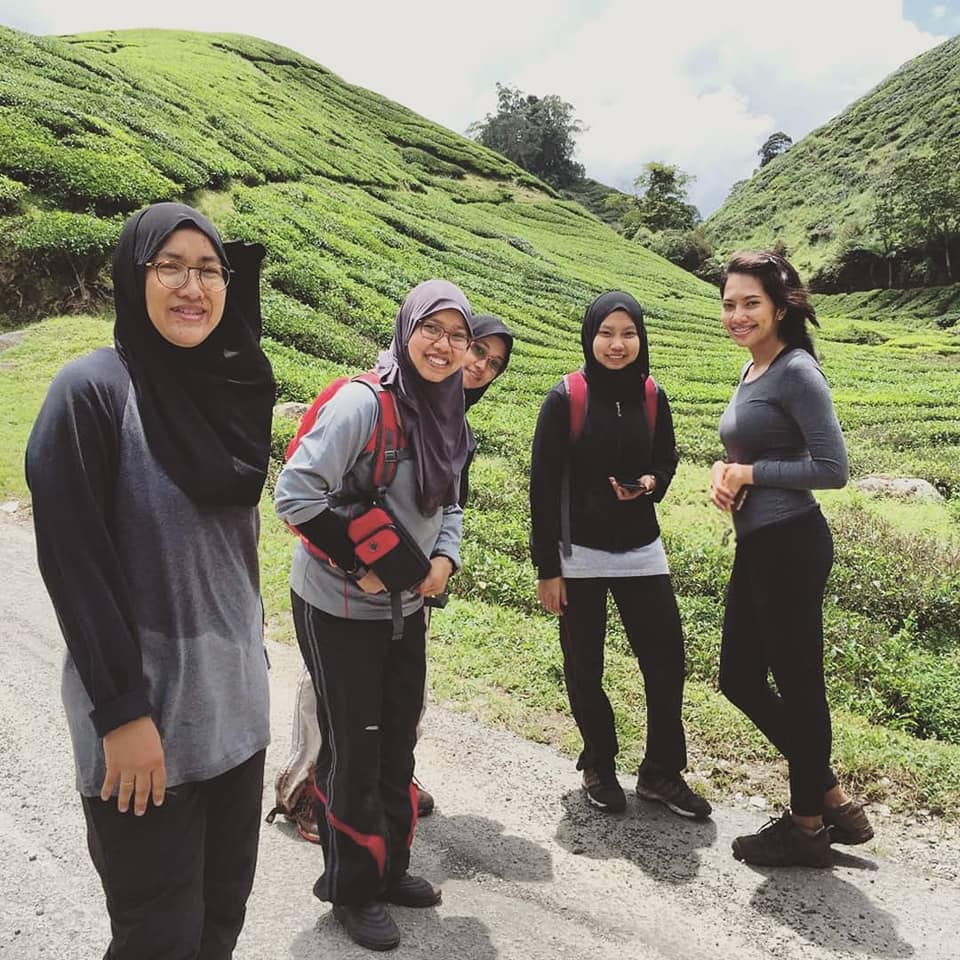
By mid-afternoon, we were back at the starting point, where our transport was waiting for us. On the way back to Cameron Square, we stopped for some photos at the edge of the tea plantation.
Mount Irau difficulty: is it suitable for beginners?
Mount Irau is usually considered an easy to moderate hike, but do not underestimate it.
There is nothing highly technical, and you do not need mountaineering skills. However, the trail is muddy, wet, uneven, and full of roots. Some sections require climbing over rocks, stepping across tangled roots, or using ropes and ladders.
The biggest challenges are:
- Cold, damp weather
- Slippery mud
- Wet tree roots
- Uneven ground
- Steep sections
- Mist and low visibility
If you’re fairly fit and comfortable walking for several hours, you should be able to manage it, especially with a guide. But if you have knee problems, poor balance, or very little hiking experience, prepare yourself properly and do not rush.
Start early to avoid being caught in the dark.


What to wear for Mount Irau
Wear comfortable hiking clothes that you don’t mind getting dirty and bring along a light jacket, especially if you’re not used to cooler climates.
The temperatures on Mount Irau range between 10°C and 25°C, depending on the weather and time of day. Temperatures may occasionally drop below 10°C.
Being a true Southeast Asian who can’t stand the cold, I wore two layers of long-sleeved tops, including a Uniqlo HeatTech thermal top and a pair of Uniqlo HeatTech leggings.

The most important thing to wear on Mount Irau is proper pair of hiking shoes or boots. Due to the moss and mud, the trail can get pretty slippery. But be forewarned: your shoes will be almost unrecognizable by the end of the hike.
To be safe, especially if you’re hiking during the rainy season, bring a raincoat or poncho as well. Gloves are optional but can be useful for holding ropes and roots.
What to bring for the Mount Irau hike
Bring a small daypack with:
- At least 1.5 to 2 liters of water
- High-energy snacks, like chocolate or cereal bars to refuel yourself before, during, or after the hike
- Packed lunch, if not included in your tour
- Hiking stick, optional but very helpful
- A phone or camera
- Power bank
- Small first-aid kit if you’re hiking independently
- An emergency blanket (although it doesn’t happen often, people do get lost, either when hiking without a guide or when they become separated from their group. You need to be able to keep yourself warm while waiting for help.)
- A whistle and headlamp, in case of emergencies
- Tissue or toilet paper
- Sunscreen – very important in Southeast Asia, and even more so at high altitudes, as you will be more exposed to the sun
- Insect repellent
- Waterproof bag or dry bag for your electronics in case it rains
- Plastic bag for rubbish
Final thoughts
Is Mount Irau Worth Visiting?
Yes, Mount Irau is absolutely worth hiking if you enjoy nature, cool weather, unusual landscapes, and trails that make you feel like you have entered another world.
It is one of the most unique hikes in Cameron Highlands and a great option if you want something more adventurous than tea plantations and strawberry farms.
That said, I would personally recommend joining a guided tour, especially if it is your first time hiking there. The guide can arrange the permit, transport, timing, and route, while also pointing out interesting plants and forest features you might otherwise miss.
More importantly, it helps make sure you actually come back out of the enchanted forest.
Because who knows what the tree roots and mud puddles are plotting in there.
* This article was originally published on Ummi Goes Where? in 2020 and has been updated for current travel planning.
Other hikes in Malaysia you may be interested in:



3 Comments