One Day in Kuala Terengganu: What We Did, Ate and Experienced
Things to do in Kuala Terengganu in one day: Kuala Terengganu 1-day itinerary
Kuala Terengganu was one of the last Malaysian state capitals I had yet to visit, so on a recent trip to Pulau Kapas, my friend and I decided to kill two birds with one stone.
Rather than drive all the way to the jetty and rush to catch a boat on the same day, we decided to spend a day and a night in Kuala Terengganu first.
As it turned out, we managed to squeeze quite a bit into our short stay, exploring some of the city’s cultural attractions and eating our way through a selection of local Terengganu dishes.
Here’s how our one-night stopover in Kuala Terengganu went.

This post may contain affiliate links, which means I may earn a commission at no extra cost to you. As an Amazon Associate, I earn from qualifying purchases. For more details, please read my Privacy Policy.
Brunch at Restoran Lempeng Rusila
After roughly five hours driving from Kuala Lumpur, we arrived at around 11 am, having had nothing besides a cup of coffee before setting off. So naturally, food was on our minds.
Fortunately, we’d done our research beforehand and planned our route so we’d arrive just in time for brunch.
The restaurant we’d decided on was Restoran Lempeng Rusila*.
*Technically, it’s in Marang, a different district from Kuala Terengganu, but it’s conveniently located along our route, just 15 minutes before reaching the city.
We picked this place because, despite its relatively limited menu, it features a range of dishes unique to Terengganu, including some I’d never tried before, even after spending more than a decade of my childhood living on the East Coast.
We ordered ketupat sotong, lempeng nyiur, rojak kateh, cendol pulut and air nyiur with ice cream. It was quite a spread for our first meal in the state. And the trip had barely even started!
Of the five things we ordered, only the last two were familiar to us.
The drink was pretty much what its name suggested: coconut water topped with a scoop of vanilla ice cream.
The cendol was familiar too, consisting of the usual green rice flour jelly strands served with shaved ice, coconut milk and palm sugar syrup. The interesting addition here was pulut, or glutinous rice.
It’s not something you’d typically find in a regular bowl of cendol, and it gave the dessert a chewier, more substantial texture.

Next up was lempeng nyiur (coconut pancake).
Lempeng is often thought of as a poor man’s breakfast: essentially a simple pancake made with only flour, water and some salt.
But in reality, it’s a comfort food that cuts across financial brackets, usually eaten when we’re too lazy to cook anything more elaborate or have simply forgotten to restock the pantry.
This version, however, had an extra ingredient: coconut. I initially imagined it would be made with grated coconut mixed into the batter, or perhaps coated in it, as you often find with many Malaysian desserts.
Instead, I found generous chunks of fresh coconut flesh tucked inside the pancake, still juicy and fleshy. It was an unexpected combination, and I quite enjoyed the contrast between the soft pancake and the chewy coconut.
The pancake was served with fish curry, which was a little on the sweet side.

The ketupat sotong was probably the most intriguing dish on the table.
It’s made by stuffing glutinous rice into squid before cooking it in a kind of sweet, creamy coconut milk gravy. I have to admit, sweet gravy wasn’t quite what I expected squid to be paired with.
I would probably have preferred something more savory, but it is what it is. Sweetness, as I was quickly reminded, seems to be a recurring theme in East Coast food.
It’s something I’d almost forgotten after no longer living there, but this meal was bringing back memories.

Then there was rojak kateh, which was something I’d never heard of before.
Unlike the fruit or noodle rojak you might be more accustomed to, this Terengganu specialty is made with kateh — the meat, skin and tendons from a cow’s lower leg — which are boiled until tender and served in a tangy, slightly spicy (and of course, slightly sweet) vinegar-based sauce.

It wasn’t our favorite of the lot. The meat had an aroma and flavor that we found a little too strong for our liking, and we hadn’t expected it to be served at room temperature rather than hot.
Still, it was an interesting dish to try, especially since it’s not something we come across very often back home.
Exploring the enormous Terengganu State Museum
With our stomachs taken care of, we headed to the Terengganu State Museum.
I’m not usually a big fan of history museums, but believe it or not, this museum was one of the main reasons I wanted to visit Kuala Terengganu in the first place.
I’d seen pictures of the building online and thought it looked absolutely stunning. Okay, so I was mostly thinking about what a perfect backdrop it would make for my OOTD 🙈. Priorities, you know.
But just like the photos, the real thing did not disappoint. In fact, I’m not exaggerating when I say this is probably the most beautiful museum I’ve seen in Malaysia.

With its traditional Malay architectural features, elaborate rooflines and intricate wooden details, the building looks more like a traditional palace than a museum.
The surrounding gardens and ponds only add to the picture-perfect setting.


As it turned out, we actually ended up staying for hours, not just taking photos, but also exploring the exhibits.
One of the more notable exhibits was the Batu Bersurat Terengganu, or Terengganu Inscription Stone. Even though history lessons were usually where you’d find me nodding off in my school chair, I do remember learning about this particular discovery.
The stone, found in Kuala Berang in 1887, bears an inscription in Jawi script dating back to 1303 CE. It is widely recognized as one of the earliest pieces of evidence of Islam’s presence and the use of Islamic law in the Malay world.

Another thing I appreciated was that some of the exhibits were interactive rather than just rows of objects behind glass.
There were sections where visitors could hold and play with wayang kulit puppets, feel different fabrics and even handle a batik stamp, the copper tool traditionally used to apply hot wax when making batik art.
You can’t actually make your own batik here, but being able to handle some of the materials and tools makes the experience a little more engaging.


There was also a Royal Gallery section, which offered a glimpse into Terengganu’s royal history through displays of royal artefacts and regalia.
It was interesting seeing this side of the state’s heritage alongside the exhibits about everyday life, traditional crafts and local culture.

One of the museum buildings wasn’t open to the public during our visit, possibly because of upgrading works. Otherwise, we would probably have stayed a lot longer.
So, if you’re anything like me and tend to skip history museums, I’d still recommend giving this one a chance and setting aside more time than you might think you need. We certainly underestimated it.
Exploring Kampung Budaya Terengganu
Also located within the museum grounds is Kampung Budaya Terengganu. We expected this to be a much quicker stop: just a walk around, a few photos of the traditional houses, and then we’d be on our way.
Well, that didn’t quite happen. This was another attraction where we ended up spending considerably longer than expected because there was actually a lot to see and learn.
The first thing that caught our attention was the collection of life-size traditional boats that gave us a sense of the coastal community’s long relationship with the sea and its fishing heritage.


Beyond those, the grounds feature different types of traditional Terengganu houses, each with its own architectural style and characteristics. And these aren’t just buildings to admire from the outside.
You can actually enter many of them and explore the interiors, with information boards explaining their features, history and traditional uses.


There were also cultural demonstrations taking place inside some of the houses.
We got to see a demonstration of gamelan, a traditional musical ensemble featuring instruments such as gongs, metallophones and drums, producing the distinctive layered melodies associated with traditional Malay performances.

Another interesting demonstration was telepuk, a traditional textile art involving the application of gold leaf or gold foil onto fabric to create decorative patterns.
It’s a rather intricate craft and not nearly as commonly seen as other traditional textile arts like batik and songket, so getting to watch a demonstration was a rare opportunity.
If you’re in the mood for a bit of dress-up, there’s also a small clothes rental corner where you can put on traditional outfits styled after Malay royalty.
You can then wander around the grounds and take photos, with the traditional houses providing the perfect backdrop.


I imagine the place must be even livelier on weekends. I noticed signage mentioning activities such as traditional games and cooking demonstrations, although these weren’t happening during our visit.
Between the traditional architecture, interactive displays and cultural demonstrations, Kampung Budaya Terengganu turned out to be much more than a quick photo stop.
It was also remarkably affordable. During our visit (2026), admission was just RM5 per Malaysian adult, the same price we paid for the Terengganu State Museum, which was an absolute bargain.
Late afternoon snacks
By the time we were done exploring both attractions, we were running seriously behind schedule.
Since we’d already booked a river cruise for 6 pm, we didn’t even have time to check in to our accommodation, let alone sit down for a proper lunch.
Luckily, the generous brunch we’d had earlier was still doing its job, and we weren’t particularly hungry.
So instead, we made a quick stop at a roadside stall for some
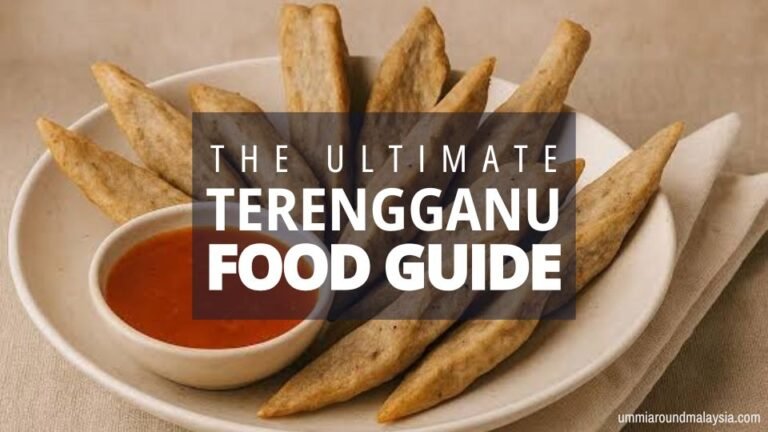
- keropok lekor, a traditional Terengganu fish snack made from ground fish and sago flour, shaped into long rolls, then boiled or fried; and
- sata, another local favorite made from fish mixed with grated coconut and spices, wrapped in banana leaves and grilled.


Both are popular snacks in the state, and they’re particularly satisfying when eaten fresh from the wok or the grill.
Keropok lekor, when done right, is crispy on the outside and chewy on the inside, while sata is softer and has a fragrant, savory filling.

We also noticed plenty of shops selling something called roti paung.
They’re small, soft, slightly sweet buns with a fluffy texture, often sold in packs and sometimes filled with butter, kaya or other sweet fillings. We bought a few packs, some to snack on during the trip and some to bring home as souvenirs.
Then, we made our way to the jetty.
Seeing Kuala Terengganu from the river
Besides being an enjoyable afternoon activity, the cruise was also a convenient way to see several of Kuala Terengganu’s major attractions in one go.
We were already short on time, so being able to tick off a bunch of landmarks without having to drive from one place to another was a definite bonus.
There are a few cruise operators in Kuala Terengganu, and they may depart from different locations.
We went with the Pak Awang River Cruise and shared the boat with a few other travelers.

The cruise took us past several landmarks, including:
- Taman Tamadun Islam
- Masjid Kristal
- Pulau Duyung
- Pasar Payang, and
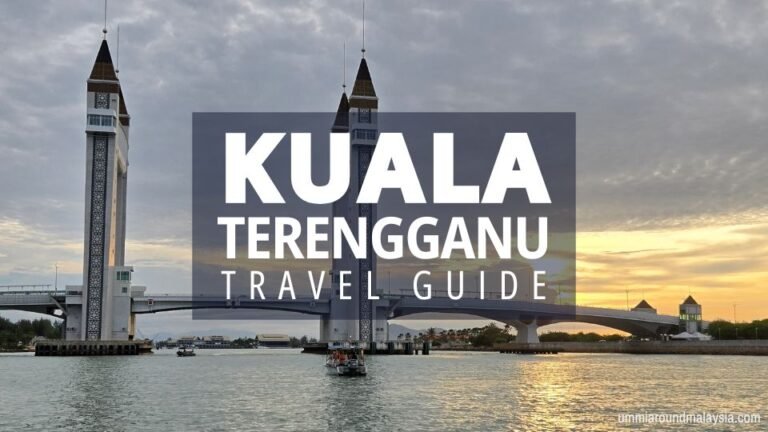
- Terengganu Drawbridge
Want to learn more about each attraction? Check out my complete Kuala Terengganu travel guide.
Our guide was first-rate, providing commentary about the places we passed along the way. He also took the time to stop the boat in front of certain attractions so we could take pictures, and even offered to help us get some photos and videos.
Judging from the results, this clearly wasn’t his first time creating content for social media.


We also passed under a bridge with some street art, which was a nice little detail we probably wouldn’t have noticed from the road.
As we made our way back, the timing couldn’t have been better. The sun was beginning to set, giving us a lovely view over the river as the sky changed color. It was a fitting end to the cruise, and one of the highlights of our short stay in Kuala Terengganu.

A quick look around the night market
Later that evening, we stopped by a night market to see if there was anything interesting to try.

Unfortunately, nothing really caught our attention. Most of what we saw were things we’d already tried elsewhere, and we didn’t spot anything that seemed particularly unique to Terengganu.
So, we decided not to buy anything.
Besides, the snacks we’d had earlier were more substantial than they looked, and we still had our roti paung in case we got hungry.
An early breakfast at Nasi Dagang Atas Tol
The next morning, we were up early and headed to Nasi Dagang Atas Tol for breakfast before continuing our journey to Pulau Kapas.
We chose the branch in Marang because it was the closest one to the Pulau Kapas jetty. There are a few other branches around Kuala Terengganu, too, so you don’t necessarily have to make the trip down south just to try it.

Another thing we liked about this branch was its setting. Some of the tables were literally on the beach, so we got to enjoy breakfast with a sea view and ease ourselves into holiday mode before even setting foot on the island.
We ordered the nasi dagang, the state’s best-known breakfast dish, which consists of a blend of rice cooked in coconut milk, traditionally served with fish curry. Ours also come with acar (pickled vegetables) and a hard-boiled egg.

We also got pulut kuning with ayam berempah, which is yellow glutinous rice served with spice-marinated fried chicken.

Both made for a hearty breakfast, but we still had room for drinks.
For that, we ordered a kopi peng (iced latte) and a Teh Peng Ombak Rindu (iced milk tea). Unfortunately, I was kicking myself for completely forgetting to ask for less sugar. We tried our best, but eventually had to admit defeat and leave some unfinished.
Still, breakfast by the beach was a lovely way to wrap up our short stay in the area. With our stomachs full and the sea just a few steps away, we were already in the mood for our next destination.
Read about our Pulau Kapas experience here.
Final thoughts

Kuala Terengganu might often be treated as just a transit point, but I think it’s worth giving the city a little of your time.
Even one night was enough for us to come away with a better appreciation of its food, culture and history, although we wish we could have stayed longer.
So, if you’re heading to Pulau Kapas, Redang, or the Perhentian Islands, I’d highly recommend spending a night in Kuala Terengganu.
It makes the road trip more manageable and saves you from having to rush straight to the islands after a long drive.
Planning your own trip? I’ve put together a complete Kuala Terengganu travel guide covering how to get there, where to stay, suggested itineraries, and other practical details to help you plan your visit.